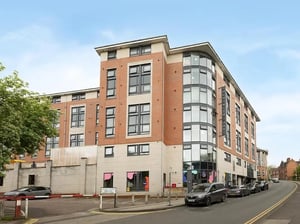
Choosing the right neighbourhood affects your rent, your commute and how much of your day disappears travelling. Nottingham's student housing splits along campus lines: the University of Nottingham's University Park and Jubilee campuses sit west and north-west of the centre, while Nottingham Trent's City Campus is in the middle of town and its Clifton Campus lies to the south. Where you study largely determines where it makes sense to live.
Lenton
Lenton is Nottingham's best-known student neighbourhood and sits directly alongside University Park Campus, which makes it the default choice for University of Nottingham undergraduates. The housing stock is dominated by Victorian and Edwardian terraces converted into shared student houses, alongside a growing number of purpose-built developments along Derby Road and Lenton Boulevard.
Most of Lenton is within a fifteen-minute walk of University Park, so many students never need public transport for lectures. The trade-off is that Lenton is emphatically a student area - busy during term, quiet in the holidays, and not the place to look if you want a mixed residential neighbourhood. Local shops, takeaways and pubs run along Derby Road and Ilkeston Road, with larger supermarkets a short walk or bus ride away.
Dunkirk
Dunkirk lies immediately south of University Park, separated from Lenton by the campus itself. It offers a quieter, more residential feel while keeping the same short commute, which is why it appeals to second and third years and to postgraduates who want distance from Lenton's intensity.
Its defining feature is the Queen's Medical Centre, one of the largest teaching hospitals in Europe and a major University of Nottingham site. For medical, nursing, midwifery and allied health students, Dunkirk is the single most practical place in the city to live. The QMC also has its own tram stop, giving Dunkirk direct tram access to the city centre and the station. Accommodation is mostly shared houses and student flats, with fewer purpose-built blocks than Lenton.
Arboretum
Arboretum is the closest residential neighbourhood to Nottingham Trent University's City Campus, close enough that most students walk to lectures in under ten minutes. It suits NTU students the way Lenton suits University of Nottingham students, and it carries a similar mix of converted period housing, student apartments and newer purpose-built accommodation.
The neighbourhood takes its name from Nottingham Arboretum, which opened in 1852 as the city's first public park and still provides the main green space in this part of town. Living here also puts you within walking distance of the city centre, so students in Arboretum tend to spend less on transport than almost anyone else in Nottingham.
Forest Fields
Forest Fields sits north of the city centre and is one of the more affordable established student areas. It has a genuinely multicultural character, with independent shops, international grocers and community facilities along the main roads.
The area borders the Forest Recreation Ground, which has its own tram stop and a large park-and-ride site, giving quick tram access to both the city centre and Nottingham Trent's City Campus. The Recreation Ground is also the site of Goose Fair each October, one of Europe's oldest travelling fairs — worth knowing before you sign, since the surrounding streets get busy for that week. Rents here typically sit below Lenton and Arboretum.
Radford
Radford occupies the ground between the city centre and University Park, which gives it something neither Lenton nor Arboretum can offer: reasonable access to both universities from one address. That makes it a practical choice for shared houses where housemates study at different institutions.
Housing is mainly terraced shared houses and student flats, with rents generally lower than the campus-adjacent areas. The neighbourhood is served by the tram along Radford Road and by frequent buses on Ilkeston Road into town. An Aldi on Radford Road covers affordable grocery shopping, and the city centre is roughly a twenty-minute walk.
Beeston
Beeston sits west of the city and borders University Park directly — students living on the eastern side can walk onto campus through Beeston Lane in around ten to fifteen minutes. It offers a proper town centre rather than a student enclave, with a High Road of independent shops, cafés, restaurants and a weekly market.
Beeston is well connected: the tram runs through Beeston Centre and Chilwell Road to the city centre and out to Toton, and Beeston railway station gives direct services to Nottingham, Derby and beyond. One practical detail worth knowing is that Beeston falls under Broxtowe Borough Council rather than Nottingham City Council, so council tax exemption is administered by a different authority — check which applies before you apply for your student exemption.
Hyson Green
Hyson Green lies north-west of the centre and is one of Nottingham's most diverse neighbourhoods, known for international supermarkets, halal butchers and independent retailers along Radford Road. For students who cook regularly or want specific ingredients from home, the food shopping here is among the best in the city.
The tram runs directly through the area, with stops at Hyson Green Market and Radford Road connecting to the city centre, Nottingham Trent's City Campus and, with one change, the University of Nottingham. Rents are consistently among the lowest of the established student areas, which is the main reason students choose it.
Mapperley
Mapperley is north-east of the city centre and offers larger houses than most student neighbourhoods, which makes it worth considering for groups of four or more who want space rather than proximity. It is a settled residential area rather than a student one, so it suits students who want to live somewhere that feels like a normal neighbourhood.
There is no tram here, so buses along Woodborough Road are the main connection into town, and the commute is longer than from Lenton or Arboretum. In exchange you get lower rents, quieter streets and easy access to green space. Housing is almost entirely shared houses and private rentals rather than purpose-built accommodation.
Sherwood
Sherwood runs along the Mansfield Road corridor north of the city centre and has an established local character, with independent cafés, delis, pubs and shops that make it feel less transient than the core student areas. It attracts postgraduates, mature students and finalists who want a quieter base.
The Mansfield Road bus corridor is one of the busiest in the city, so services into the centre are frequent throughout the day and evening. Accommodation is mainly shared houses and flats in converted properties. As in Mapperley, you trade a longer commute for lower rent and a more residential atmosphere.
City Centre
Living in Nottingham city centre puts you within walking distance of Nottingham Trent's City Campus, the railway station, the tram network and everything else the city offers. It is the strongest option for NTU students, for international students who want to arrive somewhere well connected, and for anyone who would rather not commute at all.
Accommodation here is overwhelmingly purpose-built: studios, en-suite rooms and student apartments, typically with bills included, on-site security and communal facilities. Student accommodation in Nottingham city centre costs more per week than the residential neighbourhoods, but the saving on transport and the shorter commute offset part of that. The Lace Market, Hockley and Old Market Square are all on your doorstep, along with the main shopping centres and the majority of the city's nightlife.
Choosing between them:
As a rough guide: University of Nottingham students cluster in Lenton, Dunkirk and Beeston; Nottingham Trent City Campus students in Arboretum and the city centre; and students prioritising cost look north to Forest Fields, Hyson Green, Radford, Mapperley and Sherwood. If you are at NTU's Clifton Campus, the tram terminates at Clifton South, which opens up the southern suburbs as well.